Rock The Casbah Isolated Tracks

A few years ago, I was surprised to learn the true origins of “Rock the Casbah,” the only Clash single to make the top 10 in the Billboard Hot 100.

“Rock the Casbah” was musically written by the band’s drummer Topper Headon, based on a piano part that he had been toying with. Finding himself in the studio without his three bandmates, Headon progressively taped the drum, piano and bass parts, recording the bulk of the song’s musical instrumentation himself.

This origin makes “Rock the Casbah” different from the majority of Clash songs, which tended to originate with music written by the Strummer–Jones songwriting partnership. Upon entering the studio to hear Headon’s recording, the other Clash members were impressed with his creation, stating that they felt the musical track was essentially complete. From this point, relatively minor overdubs were added, such as guitars and percussion.

However, Joe Strummer was not impressed by the page of suggested lyrics that Headon gave him. According to Clash guitar technician Digby Cleaver, they were “a soppy set of lyrics about how much he missed his girlfriend”. “Strummer just took one look at these words and said, ‘How incredibly interesting!’, screwed the piece of paper into a ball and chucked it backwards over his head.”

Strummer had been developing a set of lyrical ideas that he was looking to match with an appropriate tune. Before hearing Headon’s music, Strummer had already come up with the phrases “rock the casbah” and “you’ll have to let that raga drop” as lyrical ideas that he was considering for future songs. After hearing Headon’s music, Strummer went into the studio’s toilets and wrote lyrics to match the song’s melody.

The version of the song on Combat Rock, as well as many other Clash compilations, features an electronic sound effect beginning at the 1:52 minute point of the song. This noise is a monophonic version of the song “Dixie”. The sound effect source was generated by the alarm from a digital wristwatch that Mick Jones owned, and was intentionally added to the recording by Jones.

Sadly, Headon was kicked out of the band for heroin addiction just four days before Combat Rock was released. Also, one of my friends had that same “Dixie” digital watch when we were in the sixth grade. He annoyed the shit out of us with it.

Anyway, on to those isolated tracks …

Drums

Keys

Bass

To Crawl Or Not To Crawl

Chip Taylor, legendary songwriter and brother of Jon Voight, is still cranking ’em out at almost 80 years old. A fellow music snob turned me on to this one the other day. See what you think.

Guitar Moves With Keith Richards

https://youtu.be/ceWWMfhAvD4

A few years ago, Matt Sweeney had a chat with Keith Richards, wherein the master dropped some wisdom, told some great stories, and demonstrated the open G tuning he used on “Honky Tonk Women,” “Brown Sugar,” “Happy,” and tons of other Stones songs. Amazing stuff.

Legend is a word that’s thrown around probably too much, but there’s no real other way to describe Keith Richards. What else can you even say about the Rolling Stones guitarist? The 71-year-old is not only responsible for creating some of the most monumental music we’ve enjoyed over the last five decades, but his influence—alongside the Stones—have shaped music and the world that surrounds it. Watch our latest episode of Guitar Moves in which host Matt Sweeney lives his dream, freaks out, and sits down with Richards himself. Ever wanted to know how Richards learned how to play the guitar? Well, it started with his grandfather…

https://youtu.be/p4BH_F4zgtA

The Soul Of Rock ‘n’ Roll Is Mistakes

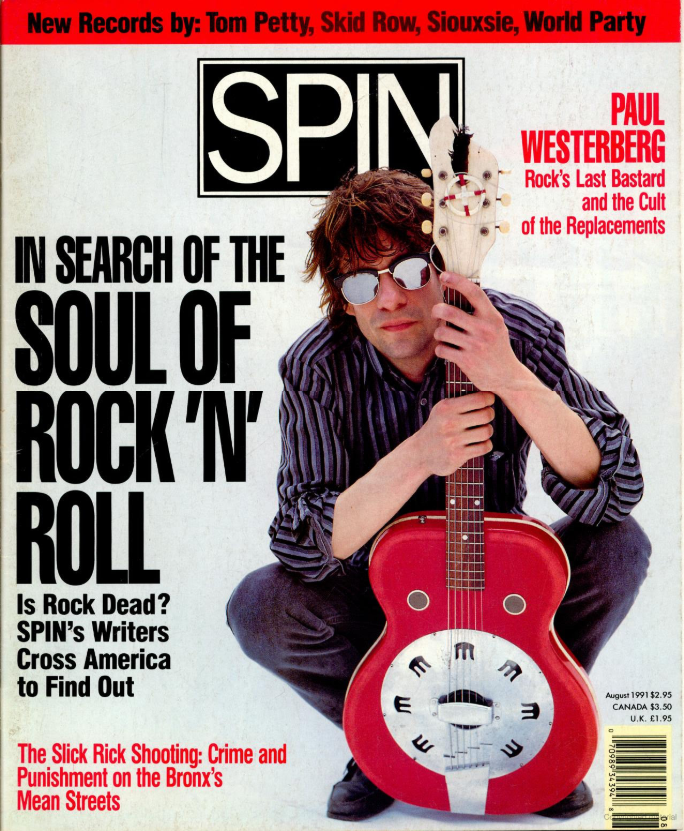
Google Books has archived every issue of SPIN, which is what my original post was going to be about. Then I started digging around in an old issue from the summer after I graduated college (August, 1991), and rediscovered an excellent Paul Westerberg interview. Apparently, rock has always been on the verge of imminent collapse, to quote the man himself. We bastards were just the other day discussing rock’s back seat in pop culture, and this edition of SPIN is 27 years old! Anyhoo, I was amused by this …

SPIN: Is rock dead?

Westerberg: Well, is jazz dead? That’s the way I look at it. Rock ‘n’ roll is underground once again, but it won’t die, just like jazz won’t. It’s not the popular music of the day, but it’s not dead.

A little later, the interviewer asks if Elvis was king, which leads to this exchange …

SPIN: What about somebody like Alex Chilton? You made him a rock hero in your song.

Westerberg: No. I don’t know what Alex represents. Now I listen to his new Rhino compilation, and it’s like, I can’t make up my mind whether Alex is some brilliant chameleon or just a guy who fucking lost it real quick. I almost regret writing that song. It’s sad, because kids will come and ask me about Alex and you’ll see this look in their eyes, and they think he’s some guy in leather pants that jumps from amplifiers or something. It’s like, if they only knew.

Interview here, every issue of SPIN here.