Al Jaffee has hopped the twig, aged 102!
Viva Nadya
This just in: Putin sucks.
You’re A Hero
I know Renfield doesn’t like to call attention to himself, but I feel obliged to post every trailer. So excited for this film.
Self-esteem anthem courtesy of Radiohead!
And Now, A Little Perspective
Whenever life gets you down, Mrs. Brown
And things seem hard or tough
And people are stupid, obnoxious or daft
And you feel that you’ve had quite enough
Just remember that you’re standing on a planet that’s evolving
And revolving at 900 miles an hour
It’s orbiting at 19 miles a second, so it’s reckoned
The sun that is the source of all our power
The sun, and you and me, and all the stars that we can see
Are moving at a million miles a day
In the outer spiral arm, at 40,000 miles an hour
Of the galaxy we call the Milky Way
Our galaxy itself contains a hundred billion stars
It’s a hundred thousand light-years side to side
It bulges in the middle sixteen thousand light-years thick
But out by us it’s just three thousand light-years wide
We’re thirty thousand light-years from Galactic Central Point
We go ’round every two hundred million years
And our galaxy is only one of millions of billions
In this amazing and expanding universe
The universe itself keeps on expanding and expanding
In all of the directions it can whiz
As fast as it can go, the speed of light, you know
Twelve million miles a minute and that’s the fastest speed there is
So remember, when you’re feeling very small and insecure
How amazingly unlikely is your birth
And pray that there’s intelligent life somewhere up in space
‘Cause there’s bugger all down here on Earth
New Wes Anderson
I like most of Wes Anderson’s films. They are quirky for sure, and not for everyone. I like his color palette, and symmetry. The script is usually pretty odd, but sometimes funny. This new one has another ensemble cast, but based on this trailer, I think it might be a miss. That being said, I don’t think any of his trailers make the films look great…
Any of you bastards fans of Wes Anderson?
Hello? Metaverse?
This Is Genius
What can a Black artist do when wronged by the law? Make art, of course! In addition to his using home surveillance video (and video shot by his wife during the raid) in this song, Afroman also posted some images to the socials.
One example was Afroman wearing a shirt with an image of [officer] Shawn Cooley beside a picture of Peter Griffin from Family Guy. Another shows [officer] Shawn Grooms next to a picture of the Hunchback of Notre-Dame. Another is of Afroman fans holding up merchandise that has images of Cooley. More include images of other officers.
So of course the cops are suing.
The complaint claims that the police officers have been “subjected to ridicule” by members of the public who have seen some of Afroman’s posts. The episode has allegedly “made it more difficult and even more dangerous” for them to carry out their official duties, the complaint adds. Some of that activity has included anonymous death threats, it says.
“As a result of Defendants’ actions, Plaintiffs have suffered damages, including all profits derived from and attributable to Defendants’ unauthorized use of Plaintiffs’ personas, and have suffered humiliation, ridicule, mental distress, embarrassment, and loss of reputation,” it reads.
Explains Afroman …
“I’m a civilian. Then, to make matters worse, I’m a Black civilian in America,” he said. “The police department was not designed to serve and protect me. I felt powerless yet angry. These guys can destroy my property and I literally couldn’t do nothing about it. The only thing I could do was take to my pen and sing about the injustice. And to my surprise, it’s going over well!”
Source here.
This Will Most Assuredly Suck
But the trailer sure is fun. President Tom Arnold?
Here’s Your Chance
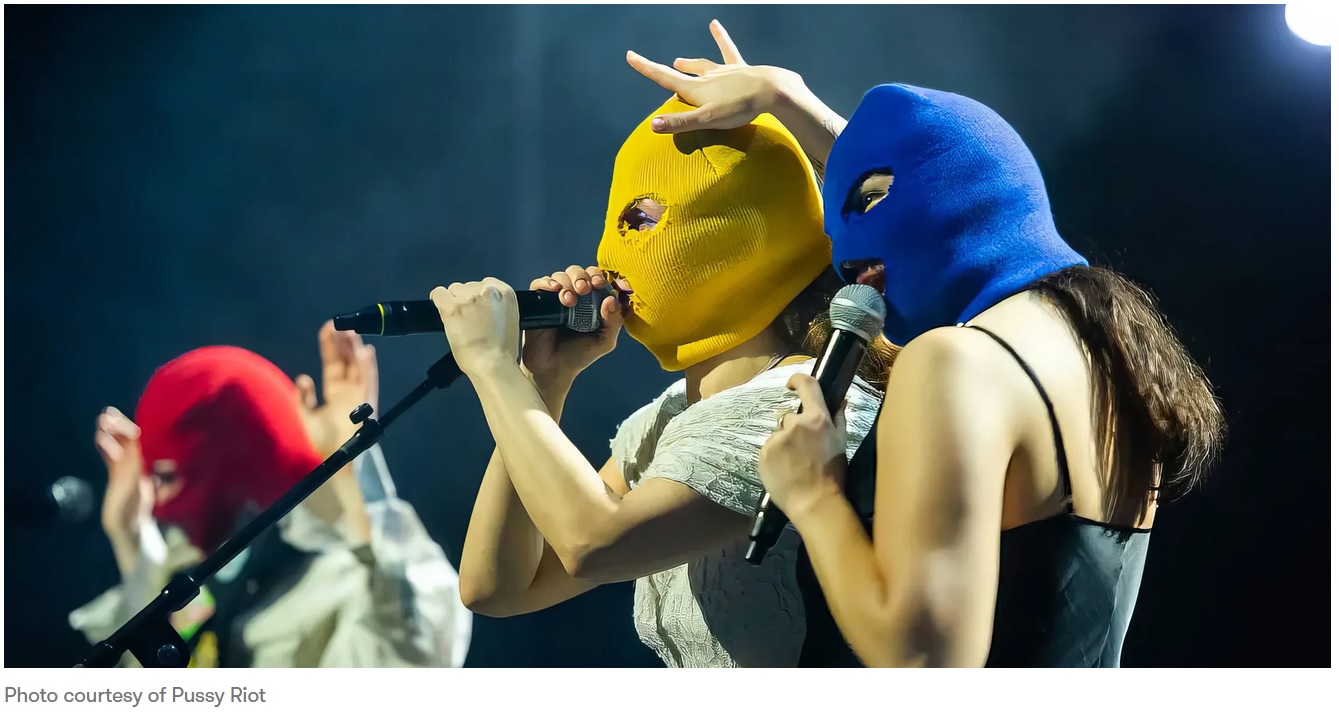
I know Monkeystador has been trying to attract Pussy Riot’s attention for awhile. Well, they’re playing in Tulsa!
You know it’s true because you read it in Pitchfork!
Pussy Riot will receive the Woody Guthrie Prize in Tulsa, Oklahoma, on May 6, and perform at the city’s Cain’s Ballroom that evening. The prize is given annually to an artist who “best exemplifies Guthrie’s spirit and work by speaking for the less fortunate through music, film, literature, dance or other art forms and serving as a positive force for social change.” The ceremony is part of the Woody Guthrie Center’s 10th anniversary celebration, which takes place from May 5 to 7.
Tulsa is a fun town. Surprisingly hip. We can go to the Dylan Archives while we’re there.