Look Around You

*checks notes*

Yep, talented people still suck.

Look Around You is a British television comedy series devised and written by Robert Popper and Peter Serafinowicz, and narrated in the first series by Nigel Lambert. The first series of eight 10-minute shorts was shown in 2002, and the second series of six 30-minute episodes in 2005, both on BBC Two. The first series of Look Around You was nominated for a BAFTA award in 2003.

The humour is derived from a combination of patent nonsense and faithful references and homages. For instance, fictional items that have a passing resemblance to everyday objects are shown and discussed. Such items include the “boîte diabolique”, a box at the top of a piano scale which housed the “forbidden notes”; and “Garry gum”, a performance-enhancing chewing gum which has the unfortunate side-effect of inducing diarrhoea, necessitating the consumption of “anti-Garry gum”. Each episode begins with a “countdown clock”, similar to the one used on ITV Schools programmes from 1979 to 1987. The music that accompanies the countdown is in the same spirit as the original, but is played on a solo guitar, and at the beginning of the “Brain” module, the guitarist can be heard tuning.

The module subjects are distorted beyond recognition; for instance, germs are described as coming from Germany, and whisky is said to be made by combining water with nitrogen. The maths module features a distorted and inaccurate version of the ancient ‘seven cats’ puzzle by Ahmes. Additionally, subjects are mixed: for example, a chemistry experiment about eggs (In the episode Water) turns into a French language lesson. Each episode follows a general format, beginning with an introduction to the subject, followed by a series of silly experiments performed by the hapless (and normally mute) scientists, played by Popper, Serafinowicz and Edgar Wright, among others.

This is “Music,” episode 6 from the first season.

Gum Disease May Cause Alzheimer’s

You bastards better keep flossing! According to NewScientist

If you bled when you brushed your teeth this morning, you might want to get that seen to. We may finally have found the long-elusive cause of Alzheimer’s disease: Porphyromonas gingivalis, the key bacteria in chronic gum disease.

That’s bad, as gum disease affects around a third of all people. But the good news is that a drug that blocks the main toxins of P. gingivalis is entering major clinical trials this year, and research published today shows it might stop and even reverse Alzheimer’s. There could even be a vaccine.

Multiple research teams have been investigating P. gingivalis, and have so far found that it invades and inflames brain regions affected by Alzheimer’s; that gum infections can worsen symptoms in mice genetically engineered to have Alzheimer’s; and that it can cause Alzheimer’s-like brain inflammation, neural damage, and amyloid plaques in healthy mice.

“When science converges from multiple independent laboratories like this, it is very compelling,” says Casey Lynch of Cortexyme, a pharmaceutical firm in San Francisco, California.

In the new study, Cortexyme have now reported finding the toxic enzymes – called gingipains – that P. gingivalis uses to feed on human tissue in 96 per cent of the 54 Alzheimer’s brain samples they looked at, and found the bacteria themselves in all three Alzheimer’s brains whose DNA they examined.

Full article here.

Wanna Know How To Spot A Fake?

Just the thing for a late afternoon distraction …

Forensic scientist Thiago Piwowarczyk and art historian Jeffrey Taylor PhD examine a purported Jackson Pollock painting and use their expertise to determine if the painting is legitimate or a forgery.

Rock The Casbah Isolated Tracks

A few years ago, I was surprised to learn the true origins of “Rock the Casbah,” the only Clash single to make the top 10 in the Billboard Hot 100.

“Rock the Casbah” was musically written by the band’s drummer Topper Headon, based on a piano part that he had been toying with. Finding himself in the studio without his three bandmates, Headon progressively taped the drum, piano and bass parts, recording the bulk of the song’s musical instrumentation himself.

This origin makes “Rock the Casbah” different from the majority of Clash songs, which tended to originate with music written by the Strummer–Jones songwriting partnership. Upon entering the studio to hear Headon’s recording, the other Clash members were impressed with his creation, stating that they felt the musical track was essentially complete. From this point, relatively minor overdubs were added, such as guitars and percussion.

However, Joe Strummer was not impressed by the page of suggested lyrics that Headon gave him. According to Clash guitar technician Digby Cleaver, they were “a soppy set of lyrics about how much he missed his girlfriend”. “Strummer just took one look at these words and said, ‘How incredibly interesting!’, screwed the piece of paper into a ball and chucked it backwards over his head.”

Strummer had been developing a set of lyrical ideas that he was looking to match with an appropriate tune. Before hearing Headon’s music, Strummer had already come up with the phrases “rock the casbah” and “you’ll have to let that raga drop” as lyrical ideas that he was considering for future songs. After hearing Headon’s music, Strummer went into the studio’s toilets and wrote lyrics to match the song’s melody.

The version of the song on Combat Rock, as well as many other Clash compilations, features an electronic sound effect beginning at the 1:52 minute point of the song. This noise is a monophonic version of the song “Dixie”. The sound effect source was generated by the alarm from a digital wristwatch that Mick Jones owned, and was intentionally added to the recording by Jones.

Sadly, Headon was kicked out of the band for heroin addiction just four days before Combat Rock was released. Also, one of my friends had that same “Dixie” digital watch when we were in the sixth grade. He annoyed the shit out of us with it.

Anyway, on to those isolated tracks …

Drums

Keys

Bass

Help Bring Satan To Springfield

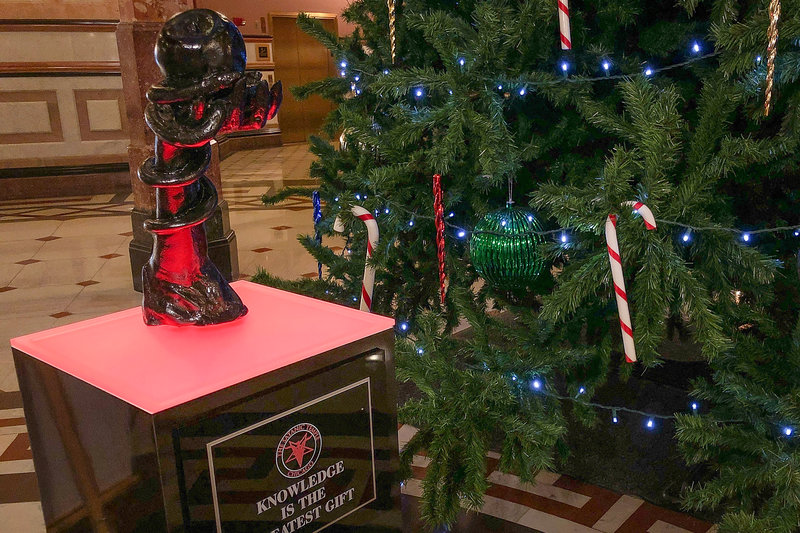
The Chicago branch of The Satanic Temple gifted the above sculpture (Eve holding the Apple of Knowledge) to the Illinois State Capitol rotunda this year. As the state cannot censor the content of speech or displays, the sculpture takes its holiday place  near Christmas and Hannukah symbols.

The principles of the Satanic Temple:

  • One should strive to act with compassion and empathy toward all creatures in accordance with reason.
  • The struggle for justice is an ongoing and necessary pursuit that should prevail over laws and institutions.
  • One’s body is inviolable, subject to one’s own will alone.
  • The freedoms of others should be respected, including the freedom to offend. To willfully and unjustly encroach upon the freedoms of another is to forgo one’s own.
  • Beliefs should conform to one’s best scientific understanding of the world. One should take care never to distort scientific facts to fit one’s beliefs.
  • People are fallible. If one makes a mistake, one should do one’s best to rectify it and resolve any harm that might have been caused.
  • Every tenet is a guiding principle designed to inspire nobility in action and thought. The spirit of compassion, wisdom, and justice should always prevail over the written or spoken word.

The rotunda boasts a fine tradition of holiday free-for-all, including a Festivus Pole a few years back.

The Soul Of Rock ‘n’ Roll Is Mistakes

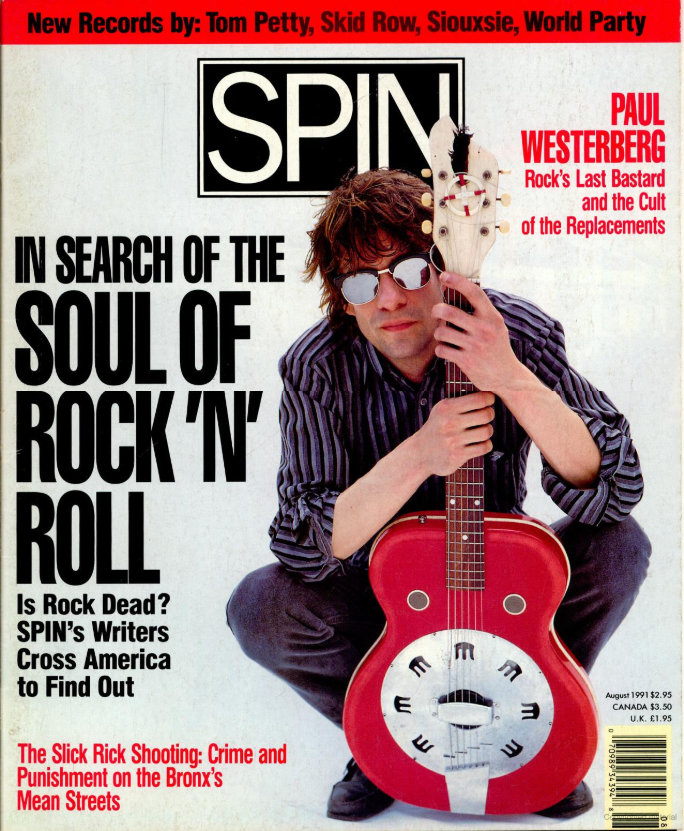
Google Books has archived every issue of SPIN, which is what my original post was going to be about. Then I started digging around in an old issue from the summer after I graduated college (August, 1991), and rediscovered an excellent Paul Westerberg interview. Apparently, rock has always been on the verge of imminent collapse, to quote the man himself. We bastards were just the other day discussing rock’s back seat in pop culture, and this edition of SPIN is 27 years old! Anyhoo, I was amused by this …

SPIN: Is rock dead?

Westerberg: Well, is jazz dead? That’s the way I look at it. Rock ‘n’ roll is underground once again, but it won’t die, just like jazz won’t. It’s not the popular music of the day, but it’s not dead.

A little later, the interviewer asks if Elvis was king, which leads to this exchange …

SPIN: What about somebody like Alex Chilton? You made him a rock hero in your song.

Westerberg: No. I don’t know what Alex represents. Now I listen to his new Rhino compilation, and it’s like, I can’t make up my mind whether Alex is some brilliant chameleon or just a guy who fucking lost it real quick. I almost regret writing that song. It’s sad, because kids will come and ask me about Alex and you’ll see this look in their eyes, and they think he’s some guy in leather pants that jumps from amplifiers or something. It’s like, if they only knew.

Interview here, every issue of SPIN here.

Help! Magazine

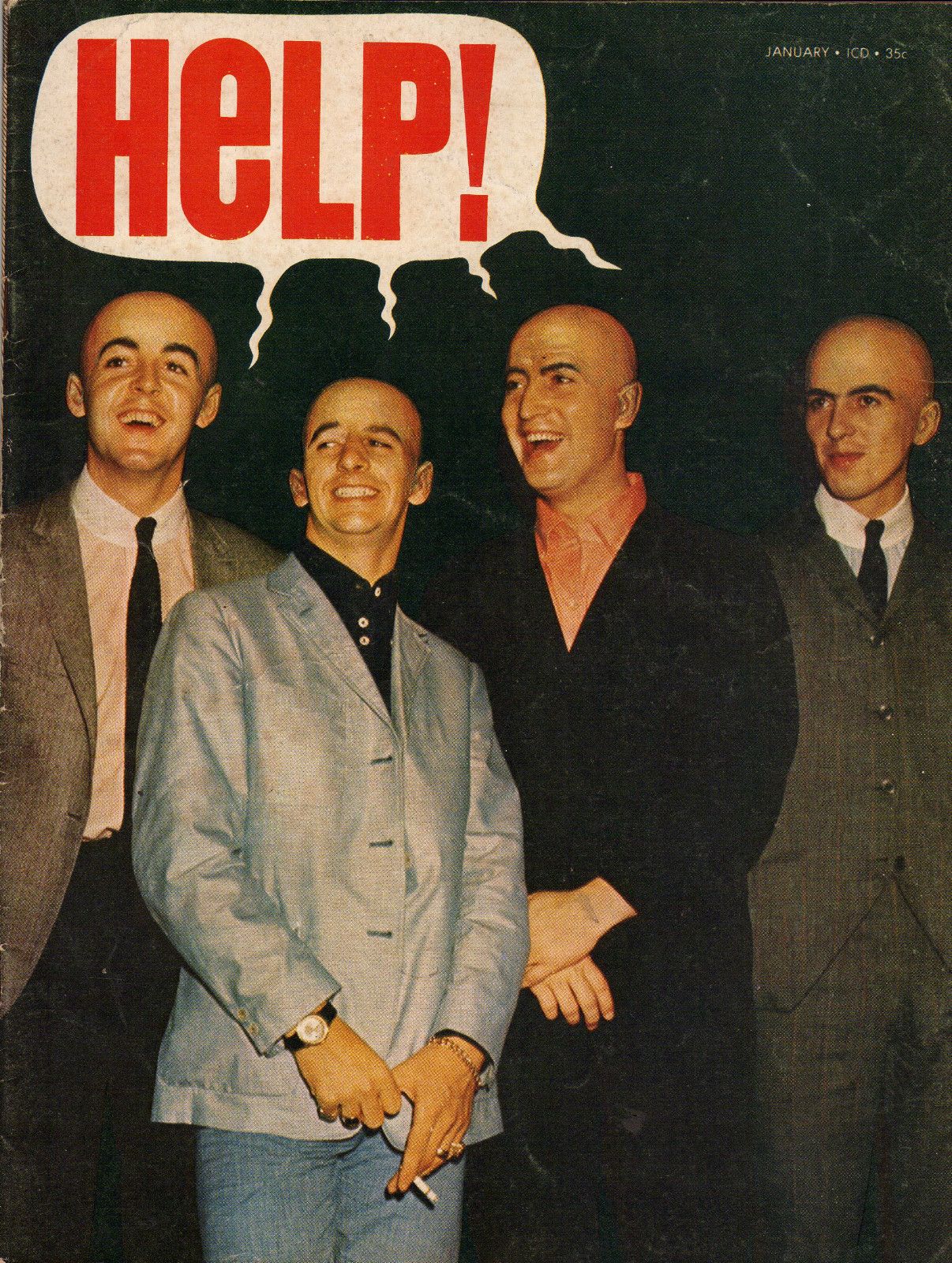
Holy shit, more pop culture dots connected. Before I forget, a few full issues of Help! are available online.

Help! is an American satire magazine that was published by James Warren from 1960 to 1965. It was Harvey Kurtzman’s longest-running magazine project after leaving Mad and EC Publications, and during its five years of operation it was chronically underfunded, yet innovative.

In starting Help!, Kurtzman brought along several artists from his Mad collaborations, including Will Elder, Jack Davis, John Severin and Al Jaffee.

Kurtzman’s assistants included Charles Alverson, Terry Gilliam and Gloria Steinem; the latter was helpful in gathering the celebrity comedians who appeared on the covers and the fumetti strips the magazine ran along with more traditional comics and text pieces. Among the then little-known performers in the fumetti were John Cleese, Woody Allen and Milt Kamen; better-known performers such as Orson Bean were also known to participate. Some of the fumetti were scripted by Bernard Shir-Cliff.

At Help!, Gilliam met Cleese for the first time, resulting in their collaboration years later on Monty Python’s Flying Circus. Cleese appeared in a Gilliam fumetto written by David Crossley, “Christopher’s Punctured Romance”. The tale concerns a man who is shocked to learn that his daughter’s new “Barbee” doll has “titties”; however, he falls in love with the doll and has an affair. Gilliam appeared on two covers of Help! and along with the rest of the creative team, appeared in crowd scenes in several fumetti.

The magazine introduced young talents who went on to influential careers in underground comix as well as the mainstream: among them Robert Crumb, Gilbert Shelton and Jay Lynch. Algis Budrys and other science fiction writers were regular contributors of prose and scripts to the magazine.

A total of 26 issues were printed before the magazine folded in 1965. Volume one (Aug. 1960–Sept. 1961) had 12 issues, and 14 issues comprised the second volume (Feb. 1962–Sept. 1965).