Stradivaritude

The recent heist of multiple vintage guitars made me wonder if perhaps the perps weren’t ambitious enough. For that much risk, you ought to aim a little higher. (And also know when a fence will go to the cops.)

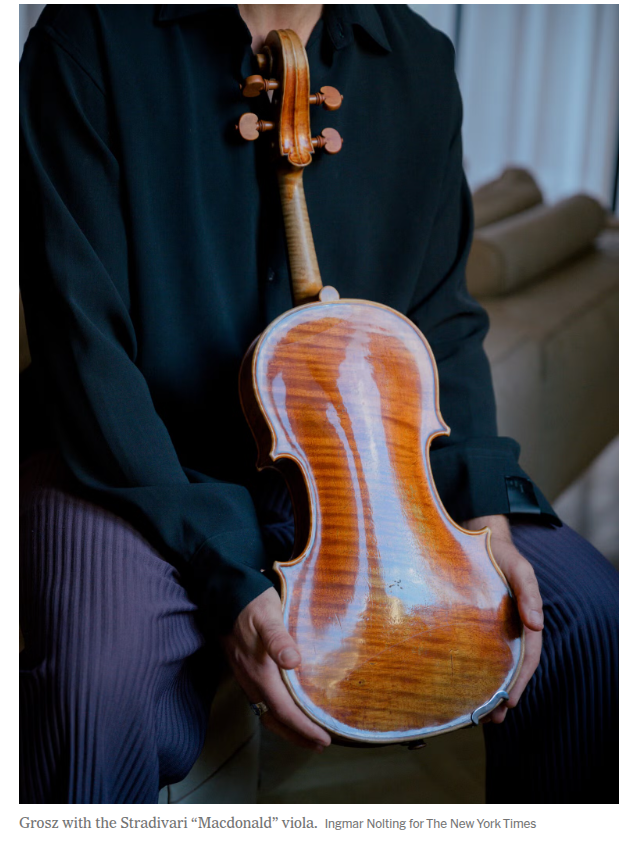
The Macdonald Stradivari viola above was purchased for $30 million + by the Stretton Society. The Society permits Amihai Grosz, the principal violist for the Berlin Philharmonic, to play it.

Stradivari violas are more rare than the violins, which themselves can fetch upward of $15 million. I think if you acquired a few of those, you probably could offload them to a fancier, more discreet clientele.

What could possibly make a viola worth more than a 1962 Gretsch White Falcon? I’m glad you asked.

In a study published in the scientific journal Public Library of Science ONE, Texas A&M biochemistry professor Joseph Nagyvary argues that Stradivari probably had no idea what made his instruments special because the crucial factor, an externally applied varnish on the wood, was beyond his apprehension or control.

Using the ashes of minute wood samples, Nagyvary analyzed the chemical makeup of violins made by Stradivari and a contemporary Cremonese maker Giuseppe Guarneri del Gesù, whose violins are thought to be near equals to Strads. The ashes of the Strad’s wood contained numerous chemicals — most notably borax and chromium — that suggest it had been aggressively treated with a varnish designed to protect against infestation. The analysis also found that the organic matrix of Stradivari’s wood was damaged and weakened, almost certainly by the application of the mineral preservative, leading Nagyvary to speculate that the wood’s porous quality allows Stradivari instruments to resonate with a rich, powerful tone.

“There is a possibility here that Stradivari received the wood pre-treated and so did not even know these minerals in his wood were the crucial factor for the sound, and this is why, despite almost surely having apprentices, the art of his instrument making was not passed on,” he says.

I have a hunch that the Angry Bass Collective – or whoever pulled off the heist – appreciates the lore of priceless instruments.

One Of These Days I’m Going To Cut You Into Little Pieces

I’m in! Incidentally, regarding “One of These Days” …

The vocals were recorded through a ring modulator, with [Nick] Mason singing in a falsetto voice and then slowed down to create an eerie effect (some compare it to the Daleks from Doctor Who, which makes the song’s usage of the show’s theme adequate). It was aimed at Sir Jimmy Young, the then BBC Radio 1 and Radio 2 DJ whom the band supposedly disliked because of his tendency to babble. During early 1970s concerts, they sometimes played a sound collage of clips from Young’s radio show that was edited to sound completely nonsensical, thus figuratively “cutting him into little pieces.”

Apologies for my recent blargh absence. Work is kicking my ass on the daily.

Shit

Maurizio Pollini, age 82.  Probably the most technically perfect of the major pianists who began their careers in the 60’s.  He studied under the obsessively perfect nutcase, Aurturo Benedetti Michelangeli.  Some considered him (and his teacher’s) playing too cerebral and cold, as if they were showing contempt for the music they were playing by playing it so perfectly.  I disagree.

La Cathedrale Engloutie


Claude Debussy’s “The Sunken Cathedral” is based on a myth involving, well, a sunken cathedral off the coast of Brittany. The beautiful princess of a prosperous coastal town named Ys had an affair either with Satan or one of his many lieutenants on earth (as beautiful princesses tend to do). As punishment, the town was destroyed by sinking into the sea along with most inhabitants. Local legend held that on certain days you could hear the bells of the cathedral of Ys ringing from below. On other days, it was believed to rise briefly to the surface. Debussy begins by representing both waves and the ringing of the cathedral bells. As the cathedral rises, chanting monks and priests emerge, culminating with the great organ at 2:25: a brief emergence of a grand, underwater zombie Mass of the damned. Then it all sinks again until we just hear the bells. Near the end, the great organ melody makes a muted reappearance from the murky depths.

Beautifully creepy stuff here, with the obsessively perfect Arturo Benedetti Michelangeli looking like he’s playing this from deep within his castle in Transylvania. (He actually never lived in a castle in Transylvania, but for a while he did live in one near Brescia).

Shit

Ray Liotta, gone too soon. Loved him in everything he did, but especially Goodfellas.

Sopranos Prequel?

Yes, please!

Young Anthony Soprano is growing up in one of the most tumultuous eras in Newark’s history, becoming a man just as rival gangsters begin to rise up and challenge the all-powerful DiMeo crime family’s hold over the increasingly race-torn city. Caught up in the changing times is the uncle he idolizes, Dickie Moltisanti, who struggles to manage both his professional and personal responsibilities—and whose influence over his impressionable nephew will help make the teenager into the all-powerful mob boss we’ll later come to know: Tony Soprano.

Eurovision 2021

I know I don’t need to tell anyone here that Måneskin’s Zitti E Buoni won Eurovision 2021. But as the blargh’s junior Eurovision correspondent, I feel obliged to include excerpts from all the performances.